

Disturbed soil environments are especially harsh and challenging to rebalance. In our applications, we have successfully remediated mining tailings, road projects, and other disturbed soils.
We have restored deteriorated soils to healthy, vital environments with soil-enhancing constituents. With the addition of beneficial nutrients, growth in these soils is further enhanced.
The following photos were taken at a copper mine where the mine tailings were planted to revegetate the disturbed areas. In the following picture, oat grass was planted to revegetate the copper mine tailings.
The treated areas showed significant improvement in root-zone and plant development. The picture below shows the root-zone development in treated and untreated plants.
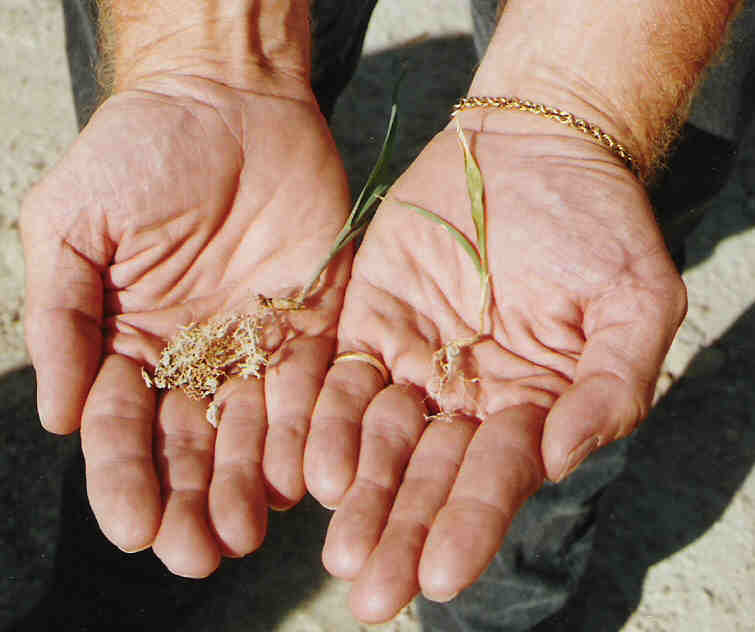
Treated on the Left — Untreated on the Right
BHP Pinto Valley Operations Copper Mine Tailings Project – Miami, Arizona
This mining operation requires over 1,000,000 tons of ore every week. The majority of the ore consists of granite and other minerals. Less than one percent is copper; typically, the grade ranges from 0.2 to 0.4 percent.
The ore is crushed, and the mineral is extracted. This process requires approximately one million tons of mine tailings to be stored each week in piles that eventually become large mountains of mine material.
This material is sterile, lacks organic matter, and is difficult to establish or sustain plant growth in.
Arizona state law, which took effect in 1992, requires these mining piles to be either capped or reclaimed through revegetation.
Capping has been extremely costly, and revegetation of the piles has been challenging. Jesse Mitchell, a BHP Environmental Technician, pioneered innovative revegetation programs that began the process of establishing plant growth on the barren tailings.
Mitchell used soil remediation products designed to biologically soften the mine waste material, add carbon, and help bring life into material that would otherwise be toxic to plants.
The program demonstrated that the propagation of vegetation is possible through soil remediation and bio-organic, probiotic programs.
Mining operations are seeking economical ways to meet the closure requirements of the EPA and AZDEQ while avoiding excessive closure costs.
BioLynceus®'s bio-organic program provides an economical alternative to help remediate mine tailings and return the mine material to a state capable of supporting regional vegetation.
The samples below are shown post-application.
Post-Treatment Vegetation Growth: Copper Mine Tailings


The case study for this project was written up by Pay Dirt Mining Magazine in December, 1997.